Regulation of plant transporters during plant fungus symbiosis
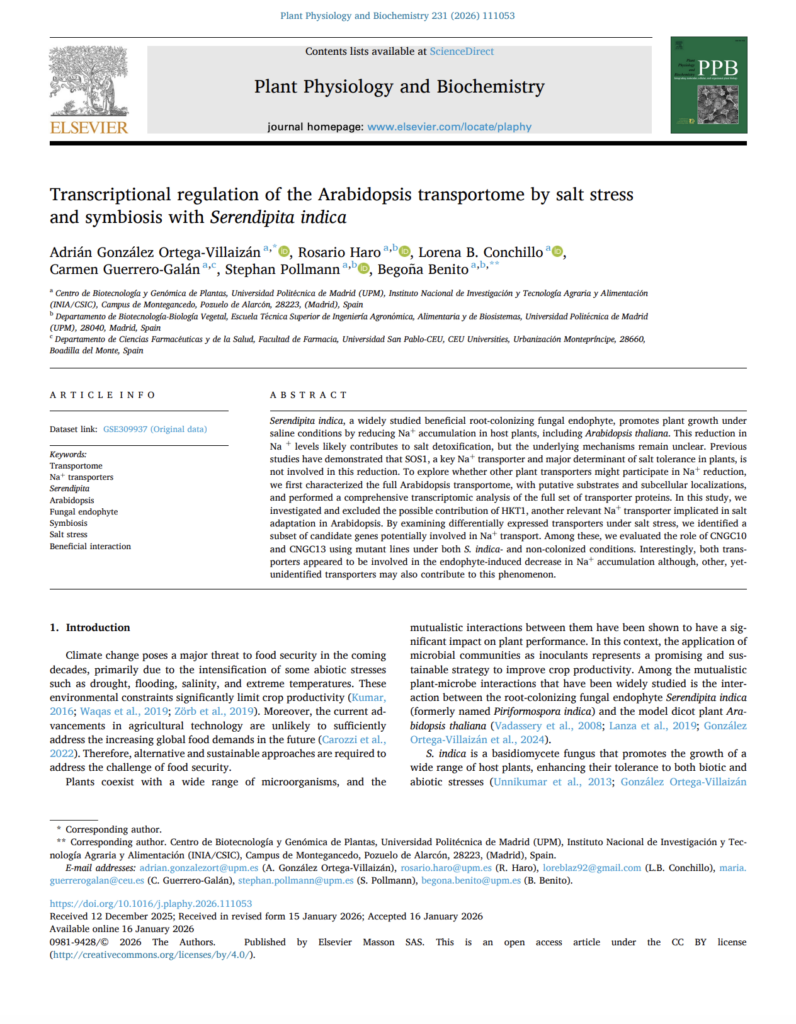
We are very happy that our most recent work got eventually published in Plant Physiology and Biochemistry. Our study investigates ionic buffering and plant transporters regulation during the interaction of Arabidopsis thaliana and Serendipita indica under salt stress conditions.
González Ortega-Villaizán, A. et al. 2026 Plant Physiology and Biochemistry
Synopsis:
Serendipita indica, a widely studied beneficial root-colonizing fungal endophyte, promotes plant growth under saline conditions by reducing Na+ accumulation in host plants, including Arabidopsis thaliana. This reduction in Na+ levels likely contributes to salt detoxification, but the underlying mechanisms remain unclear. Previous studies have demonstrated that SOS1, a key Na+ transporter and major determinant of salt tolerance in plants, is not involved in this reduction. To explore whether other plant transporters might participate in Na+ reduction, we first characterized the full Arabidopsis transportome, with putative substrates and subcellular localizations, and performed a comprehensive transcriptomic analysis of the full set of transporter proteins. In this study, we investigated and excluded the possible contribution of HKT1, another relevant Na+ transporter implicated in salt adaptation in Arabidopsis. By examining differentially expressed transporters under salt stress, we identified a subset of candidate genes potentially involved in Na+ transport. Among these, we evaluated the role of CNGC10 and CNGC13 using mutant lines under both S. indica– and non-colonized conditions. Interestingly, both transporters appeared to be involved in the endophyte-induced decrease in Na+ accumulation although, other, yet-unidentified transporters may also contribute to this phenomenon.