I am very happy that I was able to contribute to this work and that it has found its way into Frontiers in Microbiology. Wastewater irrigation, despite its appeal in water-scarce regions, poses serious risks to agriculture and public health. Untreated or poorly treated wastewater often carries pathogens that contaminate crops, particularly those eaten raw, creating pathways for disease among consumers and farmworkers who have direct contact with the water. Prolonged use also degrades soil quality through salinization, especially in arid climates where evaporation concentrates salts in the topsoil, while heavy metals from industrial effluent can accumulate over time, disrupting soil fertility and microbial health. Compounding these issues, emerging contaminants such as pharmaceuticals, hormones, and microplastics can be absorbed by crops and enter the food chain, while antibiotic residues contribute to the growing problem of antimicrobial resistance. These risks are especially pronounced in developing countries, where limited treatment infrastructure and weak regulatory oversight mean wastewater often reaches fields with minimal purification. As a result, both ecosystems and communities face cumulative, sometimes invisible harm that can take years to become fully apparent, underscoring the need for stronger safeguards, better treatment systems, and more careful management wherever wastewater is used for irrigation.
Shah et al. 2026 Frontiers in Microbiology
Synopsis
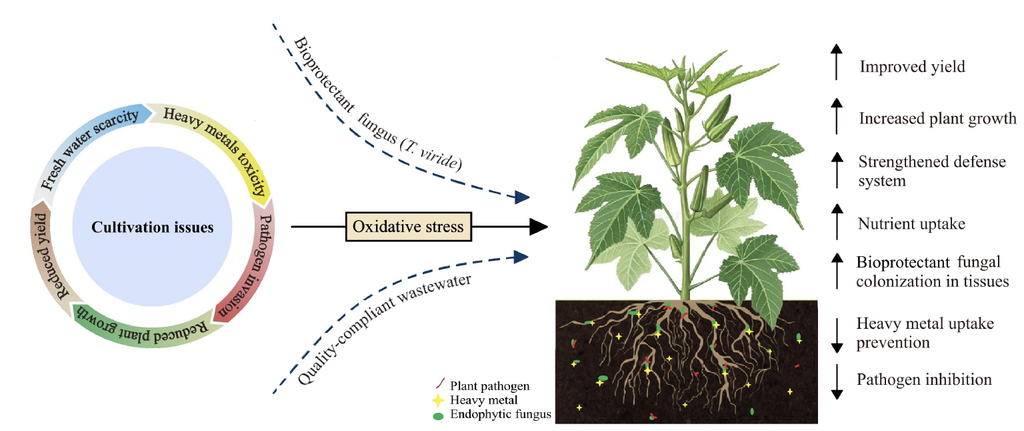
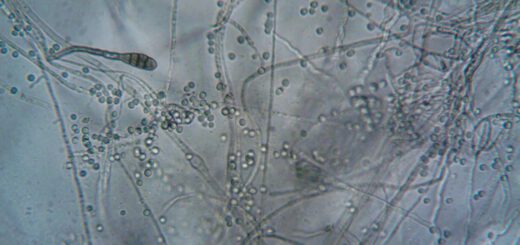
Irrigation water quality markedly shapes plant growth and physiological functioning, particularly under integrated biotic and abiotic stresses. This study evaluated the influence of irrigation water types, tap water (TW), domestic wastewater (DWW), Lyari wastewater (LWW), and Malir wastewater (MWW), interacting with wastewater-isolated bioprotectant Trichoderma viride on Abelmoschus esculentus infected with soil-borne pathogens Fusarium oxysporum and Rhizoctonia solani. Morphological traits, together with ITS amplicon sequencing and BLAST analysis, confirmed T. viride (PZ212855). Plants treated with LWW and T. viride showed pronounced enhancements in agronomic and physiological traits, i.e., enhanced plant height, fresh biomass, dry biomass, leaf number, fruit fresh biomass, chlorophyll a, chlorophyll b, total chlorophyll, carotenoids, and total soluble proteins. These increases corresponded with the greater nutrient content of LWW and DWW, which met FAO irrigation standards. DWW upgraded plant functioning, but its slightly higher arsenic concentration required mitigation using T. viride in the rhizosphere. MWW, exhibiting greater physicochemical loads and higher arsenic, generated oxidative stress, increased H2O2 and MDA, and reduced growth. T. viride partially mitigated these effects by regulating antioxidant enzyme activity. Overall, integrating nutrient-rich wastewater with T. viride improved plant growth, yield, and stress resilience under challenging conditions.